
Description
PFM Crown Restorations from a China Dental Lab
TL;DR — A PFM crown pairs a cast metal coping with layered porcelain, and that is why it still carries heavy posterior loads better than most all-ceramic options. Hecheng (Shenzhen) Medical Dental Lab builds PFM crowns and bridges on cobalt-chromium, nickel-chromium and precious frameworks, then checks every unit against four written criteria before packing. Standard cases leave our bench three to four working days after the model arrives.
When a PFM crown beats full-contour zirconia
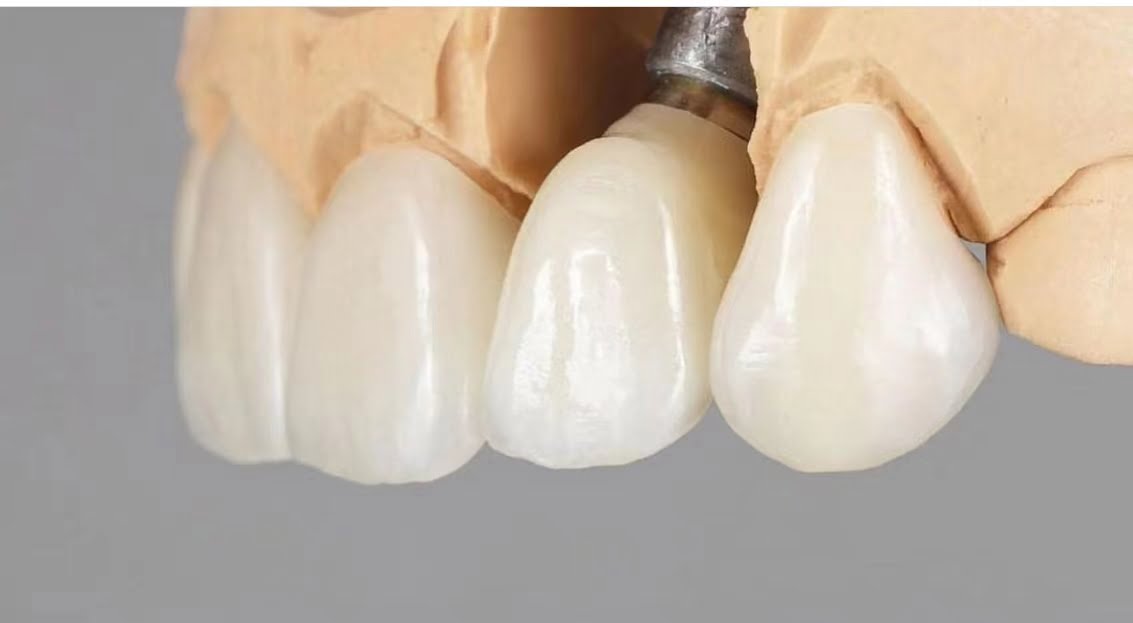
PFM is not the newest option, so it is fair to ask when we actually recommend it. We reach for it in four situations: molar units under heavy load, long-span bridges where flexure matters, bruxism cases where chipping is the main risk, and budgets that rule out layered zirconia. It also stays the common choice for an implant restoration built over a titanium base.
However, we do not push it everywhere. If a case is anterior and translucency drives the result, we usually steer the prescription toward lithium disilicate or layered zirconia instead. Because we run all three routes under one roof, that advice costs you nothing.
Choosing the metal framework
The alloy under the porcelain decides most of the outcome, so we quote it as a choice rather than a default.
- Cobalt-chromium (Co-Cr) — nickel-free and beryllium-free, good biocompatibility, stable price. This is the mainstream economical choice for export orders.
- Nickel-chromium (Ni-Cr) — the lowest price point. Its drawback is gingival greying at the margin over time, so most markets have largely replaced it.
- Precious alloy (Pd-Au / Pd-Ag) — best tissue response, a warmer underlying colour that reads more naturally through the porcelain, and high strength. It costs the most.
Tell us which one your market expects. Therefore we can match both the clinical requirement and what your patients are willing to pay.
How we build one
A metal-ceramic unit passes through fifteen steps at our lab, and each of them exists because skipping it shows up in the mouth later:
- Disinfect and log incoming cases, then sort them into their shipping-date bins
- Inspect the model, pour stone, trim the abutment, mount on the articulator
- CAD/CAM scan — digital file or printed model from your scan data
- CAD the coping, or print it directly on our Co-Cr laser metal printer
- Nest and cut, then stain and sinter
- Fit the metal framework on the die
- Build porcelain powder layer by layer
- Carve the anatomy, glaze, then sandblast and polish
- Quality control, then disinfect and pack
What we check before it ships
QC runs against our shipping standard and against the preferences already recorded for your practice. Concretely, every unit gets four checks:
- Seating — margins reach the designed position, occlusion is correct, nothing rocks
- Contact — tight interproximal contact, no food impaction
- Occlusion — even loading, no interference
- Form — contour and shade read correctly, and chewing function is restored
Because we keep your stated preferences on file, we can keep fit tolerance, contact tightness and polish level steady across repeat cases instead of starting from scratch each time.
And if a unit still comes back not matching your prescription, tell us within 30 days of delivery. We remake or adjust it at no charge, and we cover the return freight both ways.
PFM crown options
- Single PFM crown, anterior or posterior
- PFM bridge — double-ended, semi-fixed, cantilever or compound design
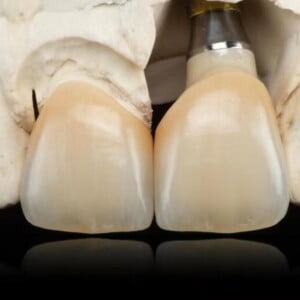
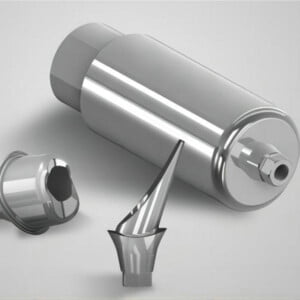
- Implant PFM crown over a titanium base with our custom individual abutment
- Shade to your prescription
Files we accept
Our design rooms run 3Shape and EXOCAD, so we take digital cases from those ecosystems as well as conventional ways of working. Send an intraoral scan, or send stone models and polyvinyl impressions. Therefore neither workflow holds up the case.
Turnaround, shipping and getting started
Most work completes three to four working days after we receive the model. Then China-to-US and China-to-EU shipping takes roughly two working days door to door. Add those together and your total cycle is about one week.
Start with a 50-unit trial order, or send one difficult case if you want to test us first. We scale from trials to high monthly volume without changing the team that makes your units. You can also see the related metal-ceramic bridge we run alongside this work.
Our quality system holds ISO 13485:2016 certification from SGS, so the process above is audited rather than merely described. The ISO 13485 standard itself sets out what that covers.
We supply dental professionals only. Ready to send a case? Email info@cndentalfactory.com.
Reviews
There are no reviews yet.